Red Carpet Wardrobe Malfunctions: Prevention for 2026 Events
Advertisements
Red carpet wardrobe malfunctions, though often sensationalized, are meticulously prevented by a dedicated team of professionals employing advanced techniques and contingency plans to ensure flawless celebrity appearances at high-profile events.
Have you ever wondered about the hidden efforts behind those dazzling red carpet appearances? The world of high fashion and celebrity events is glamorous, but it’s also a high-stakes environment where a single misstep can lead to a viral moment for all the wrong reasons. This article delves into red carpet wardrobe malfunctions, exploring some infamous past incidents and, more importantly, revealing the elaborate strategies and dedicated professionals who work tirelessly to prevent such fashion emergencies for events like those planned for 2026.
The high stakes of red carpet fashion
The red carpet is more than just an entrance; it’s a meticulously choreographed stage where fashion statements are made, careers are boosted, and millions of eyes scrutinize every detail. For celebrities, designers, and stylists, a flawless appearance is paramount, as it reflects not only personal brand but also the artistry of the fashion industry. The pressure is immense, and the potential for a wardrobe malfunction, however minor, can turn a triumphant moment into an embarrassing headline.
Understanding the gravity of these events helps us appreciate the intricate planning involved. Every gown, every suit, and every accessory is chosen with purpose, and every step is practiced. The goal is always perfection, and the fear of a fashion faux pas drives an extensive behind-the-scenes operation dedicated to prevention.
The impact of a wardrobe malfunction
A wardrobe malfunction on the red carpet can have far-reaching consequences. For the celebrity, it can mean immediate public scrutiny, negative press, and a lasting image associated with the incident. For designers and brands, it can damage reputation and overshadow months of creative work.
- Media frenzy: Incidents are often amplified by social media and news outlets.
- Brand perception: Can negatively affect designers and stylists.
- Personal embarrassment: Celebrities face intense public and media scrutiny.
- Career implications: May lead to hesitation for future collaborations.
The stakes are incredibly high, which is why the prevention protocols have become increasingly sophisticated. From the initial fitting to the moment a celebrity steps onto the carpet, every detail is considered and double-checked to mitigate any potential risks, ensuring that the focus remains on the fashion and the event itself, not on an unexpected mishap.
Infamous red carpet wardrobe malfunctions: lessons learned
History is replete with examples of red carpet moments that went awry, serving as cautionary tales for future events. These incidents, while often memorable for the wrong reasons, have significantly influenced the evolution of prevention strategies within the industry. By dissecting these past mishaps, stylists and designers gain invaluable insights into potential vulnerabilities and develop more robust contingency plans.
One classic example involves a gown with an unexpectedly revealing slit that caused discomfort and awkward posing for a prominent actress. While the dress was stunning, its construction overlooked the practicalities of movement and photography on a bustling red carpet. This incident highlighted the critical need for comprehensive movement testing during fittings, ensuring that garments hold up under various conditions and angles.
Case study 1: the unexpected split
In the early 2010s, a beloved actress suffered an embarrassing moment when the high slit of her designer gown revealed more than intended as she navigated the red carpet. The dress, while fashion-forward, lacked proper reinforcement or a discreet lining to manage the split’s movement. This immediately became a viral sensation, overshadowing her award nomination.
- The issue: An overly ambitious high slit combined with movement.
- Lesson: The importance of practical wearability over pure aesthetics.
- Prevention for 2026: Reinforced seams, strategic inner linings, and extensive movement tests.
This incident spurred a significant shift in how designers approach high-slit gowns. Now, internal structures, invisible mesh, and even discreet buttons or snaps are often integrated to ensure controlled movement and prevent accidental exposure. Stylists also prioritize instructing celebrities on how to pose and walk in such garments, adding another layer of prevention.
The dreaded ‘nip slip’ and how it’s avoided
Perhaps one of the most common and widely publicized wardrobe malfunctions is the ‘nip slip,’ an accidental exposure that can occur with strapless gowns, plunging necklines, or ill-fitting tops. These incidents are particularly challenging to prevent because they often stem from subtle shifts in garment positioning or unexpected movements. The focus here is on securing the garment to the body with unwavering precision.
The industry has developed an arsenal of tools and techniques specifically designed to combat this particular type of malfunction. From specialized tapes to custom-fitted undergarments, every effort is made to ensure that garments stay exactly where they are intended to be, regardless of the wearer’s activity or the camera’s angle. This proactive approach is crucial for maintaining both the celebrity’s comfort and their public image.
Case study 2: the uncooperative neckline
A few years ago, a pop icon attending a major music awards show experienced a brief but widely photographed ‘nip slip’ due to a low-cut, unstructured top. The garment’s design, while fashion-forward, offered minimal support, and a sudden movement led to the unfortunate incident. This moment underscored the necessity of robust garment engineering and body-to-garment adhesion.
- The issue: Lack of structural support in a plunging neckline.
- Lesson: Garments need to be engineered for movement and security.
- Prevention for 2026: Industrial-strength double-sided tape, built-in corsetry, and custom bras.
For 2026 events, stylists are employing an array of adhesives, including medical-grade fashion tape, body glue, and even specially designed silicone patches, to anchor plunging necklines and strapless designs. Custom-made bras and built-in corsetry are also increasingly common, offering seamless support and structure that prevents any unwanted movement, ensuring that celebrities can move with confidence and grace.
Fabric mishaps: rips, tears, and transparency issues
Beyond accidental exposure, fabric-related malfunctions—such as rips, tears, or unexpected transparency under flash photography—pose another significant challenge on the red carpet. Delicate fabrics, intricate embellishments, and custom tailoring can all contribute to vulnerabilities if not properly managed. The key here is anticipating potential stress points and ensuring material integrity.
These types of malfunctions often arise from the inherent properties of certain materials or the stress placed on seams and threads during wear. High-quality craftsmanship and meticulous inspection are critical in mitigating these risks. Stylists and designers work collaboratively to select fabrics that are not only aesthetically pleasing but also robust enough to withstand the rigors of a red carpet event.
Case study 3: the sheer surprise
At a high-profile movie premiere, a celebrity’s seemingly opaque dress turned surprisingly sheer under the glare of flash photography, revealing undergarments in an unintended way. The fabric, while beautiful in natural light, reacted unexpectedly to intense camera flashes. This highlighted a common issue with certain materials and the need for flash testing.
- The issue: Fabric transparency under flash photography.
- Lesson: All garments must be tested under various lighting conditions.
- Prevention for 2026: Layering with opaque linings, flash testing all garments, and selecting photo-friendly fabrics.
To prevent such ‘sheer surprises’ for 2026, stylists now conduct thorough flash tests on all red carpet ensembles, often simulating the exact lighting conditions of the event. Designers are also increasingly incorporating opaque linings into delicate or sheer fabrics, or opting for materials known to perform well under intense photography, ensuring that garments maintain their intended opacity and elegance.
Professional prevention strategies for 2026 events
The prevention of red carpet wardrobe malfunctions is a multi-faceted process involving a dedicated team of professionals, state-of-the-art techniques, and rigorous planning. For 2026 events, these strategies are more sophisticated than ever, integrating technology with traditional craftsmanship to ensure flawless celebrity appearances. The focus is on a holistic approach, addressing every potential vulnerability from conception to execution.
This proactive methodology extends beyond just the garment itself, encompassing the celebrity’s movements, the event environment, and even potential weather conditions. Every detail is considered, creating a robust safety net that minimizes the chances of any fashion mishap. The goal is not just to fix problems, but to prevent them from ever occurring.
The role of the stylist and glam squad
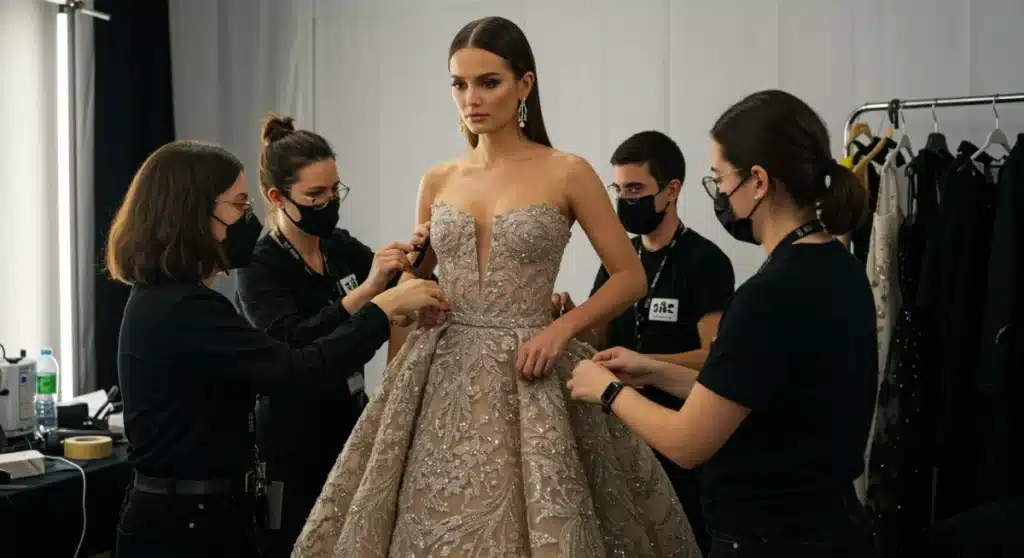
The stylist is the orchestrator, overseeing the entire look from head to toe. They work closely with designers to ensure the garment is perfectly tailored and suitable for the event’s demands. The glam squad, including hair and makeup artists, also plays a crucial role in ensuring the overall cohesion and security of the look.
- Multiple fittings: Ensuring a perfect, custom fit that allows for movement.
- Movement testing: Practicing sitting, walking, and posing in the outfit.
- Emergency kits: Stylists always carry a comprehensive kit with tools for immediate repairs.
- Pre-event checks: Final inspection of every seam, button, and accessory just before the carpet.
For 2026, stylists are leveraging 3D body scanning for precise measurements and virtual fittings, reducing the need for numerous physical sessions while ensuring an impeccable fit. They also coordinate with security teams to manage crowd control, providing controlled pathways for celebrities, which minimizes jostling and potential garment damage.
The technology and tools behind flawless appearances
Modern prevention techniques for red carpet wardrobe malfunctions are increasingly incorporating advanced technology and specialized tools. These innovations provide an extra layer of security and precision, ensuring that even the most intricate and delicate ensembles remain perfectly intact throughout the event. The industry is constantly evolving, adopting new solutions to old problems.
From custom-engineered fabrics to smart adhesives, the arsenal available to stylists and designers is more impressive than ever. These technological advancements not only enhance garment security but also contribute to the overall comfort and confidence of the celebrity, allowing them to fully enjoy their moment in the spotlight without fear of a fashion faux pas.
Innovations in garment construction
Designers are now employing advanced textile engineering and construction techniques to build more resilient and secure garments. This includes integrating invisible support structures and using fabrics with enhanced durability and stretch.
- Seamless integration: Built-in shapewear and corsetry for discreet support.
- Smart fabrics: Materials that resist wrinkles, tears, and static cling.
- Reinforced seams: Using specialized stitching and interlining for high-stress areas.
Looking ahead to 2026, we can expect to see wider adoption of smart textiles that can adapt to environmental changes, offering better temperature regulation and increased elasticity without compromising aesthetics. Furthermore, the use of laser-cutting and 3D printing in garment construction allows for unprecedented precision in tailoring, minimizing potential points of failure.
| Key Aspect | Prevention Strategy for 2026 |
|---|---|
| Unexpected Splits | Reinforced seams, strategic inner linings, and extensive movement testing. |
| Uncooperative Necklines | Industrial-strength fashion tape, built-in corsetry, and custom support. |
| Fabric Transparency | Opaque layering, rigorous flash testing, and photo-friendly fabric selection. |
| Overall Security | Multiple fittings, emergency kits, pre-event checks, and advanced garment construction. |
Frequently asked questions about red carpet wardrobe malfunctions
The most common types include accidental exposure (often called ‘nip slips’), unexpected tears or rips in delicate fabrics, and garments turning transparent under intense flash photography. These incidents frequently stem from ill-fitting clothing or unforeseen movements.
Stylists employ multiple fittings, rigorous movement testing, and strategic use of industrial-strength fashion tape, body glue, and built-in support structures. They also carry comprehensive emergency kits for immediate, last-minute repairs backstage.
Increasingly, yes. Professionals now routinely conduct flash tests on red carpet ensembles to ensure that fabrics maintain their intended opacity and appearance under the intense glare of professional photographers’ lights, preventing unintended transparency.
An emergency kit is a stylist’s essential toolkit containing items like double-sided tape, safety pins, sewing kits, stain remover, static guard, lint rollers, and even spare undergarments. It’s designed to address any last-minute fashion crisis quickly.
Technology now aids prevention through 3D body scanning for precise fittings, advanced fabric engineering for more durable and smart materials, and virtual reality simulations for movement testing. These innovations enhance both security and comfort for celebrities.
Conclusion
The glitz and glamour of the red carpet, while seemingly effortless, are the result of an extraordinary level of planning, precision, and professional expertise. As we’ve explored, red carpet wardrobe malfunctions are not just accidental occurrences but significant challenges that the fashion industry actively works to mitigate. Through a combination of meticulous fittings, advanced garment construction, strategic use of specialized tools, and the vigilant eye of dedicated stylists and their teams, the risk of a fashion faux pas is dramatically reduced for events in 2026 and beyond. The lessons learned from past incidents continue to inform and refine these preventive measures, ensuring that celebrities can grace the red carpet with confidence, showcasing the art of fashion without fear of unexpected mishaps. The behind-the-scenes world is a testament to the dedication required to maintain the illusion of seamless perfection.